
But just take your time, and you’ll get through it 🙂
Table of Contents
Korean Reading Practice
Are you ready ?
Vocabulary
| 한국어 | 영어 |
|---|---|
| 도착하다 | to arrive |
| 피곤하다 | to be tired |
| 기분 | feeling, mood |
| 정말 | really |
| 좋다 | to be good |
| 살다 | to live |
| 깨끗하다 | to be clean |
| 가깝다 | to be close |
| 원룸 | studio (apartment) |
| 새롭다 | to be new |
| 찾다 | to find |
| 가격 | price |
| 싸다 | to be cheap |
| 주방 | kitchen |
| 조용하다 | to be quiet |
| 창문 | window |
| 크다 | to be big |
| 도와주다 | to help |
| 준비 | preparation |
| 무슨 | what, which |
| 말 | word, speech |
| 만나다 | to meet |
Grammar points
-을/ㄹ 수 있어요 / 없어요
을 수 있어요 and 을 수 없어요 are used to express the ability or inability to do something in Korean, similar to “can” and “cannot” in English.
| 을 수 있어요 | 을 수 없어요 |
| “can”, “able to do something” FORMATION Verb stem + 을 수 있어요 (if the verb stem ends in a consonant) Verb stem + ㄹ 수 있어요 (if the verb stem ends in a vowel) | “cannot”, “unable to do something” FORMATION Verb stem + 을 수 없어요 (if the verb stem ends in a consonant) Verb stem + ㄹ 수 없어요 (if the verb stem ends in a vowel) |
Examples
| 을 수 있어요 | 을 수 없어요 |
| 읽을 수 있어요 : “I can read.” 할 수 있어요 : “I can do it.” 수영할 수 있어요 : “I can swim.” 갈 수 있어요 : “I can go” | 읽을 수 없어요 : “I can’t read.” 할 수 없어요 : “I can’t do it.” 수영할 수 없어요 : “I can’t swim.” 갈 수 없어요 : “I can’t go” |
-고
-고 is a connector that links verbs or adjectives, similar to “and” in English.
Formation
- Verb/Adjective stem + -고
Example
- 깨끗하고 좋아요 “It is clean and nice.”
- 깨끗하다 (to be clean) + -고 = 깨끗하고
어야 하다 / 되다
어야 하다 and 어야 되다 mean “must” or “have to” in English. It’s used to express necessity or obligation.
Formation
- Verb stem + -어~아야 하다/되다
- The ending depends on the vowel in the verb stem:
- If the last vowel in the stem is ㅏ or ㅗ, use 아야 하다/되다.
- For other vowels, use 어야 하다/되다.
Examples
- 찾아야 해요
찾다 (to find) + -아야 하다 = 찾아야 해요 → “I have to find…”
싸야 해요
싸다 (to be inexpensive) + -아야 하다 = 싸야 해요 → “It has to be cheap…”
가까워야 해요
가깝다 (to be close) + -아야 하다 = 가까워야 해요 → “It has to be close…”
V-는 / A-(으)ㄴ
Turns an adjective (예쁘다) or a verb (먹다) into a noun modifier, a word that will describe the noun it precedes. In the text, we see these noun modifiers in the present tense, which we will focus on.
- FOR VERBS
V + 는 -> Take the verb stem and add -는
- FOR ADJECTIVES
A + (으)ㄴ -> Take the adjective stem and add 은 or ㄴ, depending on whether the
adjective stem ends with a consonant or a vowel.
Consonant : 높다 => 높 + 은 => 높은
Vowel : 예쁘다 => 예쁘 + ㄴ => 예쁜
Some examples from the story :
- 하지만 비누 씨의 집은 작은 원룸이에요. (But Binu’s place is a small studio)
작다 (small) is an adjective – A + (으)ㄴ => 작은 => 작은 원룸 (small studio) - 그래서 저는 새로운 집을 찾아야 해요. (So I have to find a new house)
새롭다 (new) is an adjective (ㅂ irregular) – A + (으)ㄴ => 새로운 => 새로운 집 (new house) - 그리고 저는 조용한 집이 좋아요. (And I like quiet places)
조용하다 (quiet) is an adjective – A + (으)ㄴ => 조용한 => 조용한 집 (quiet house) - 창문이 큰 집이 좋아요. (I like a house with big windows)
크다 (big) is an adjective – A + (으)ㄴ => 큰 => 큰 집 (big house)
Korean Time System
Korean Time System
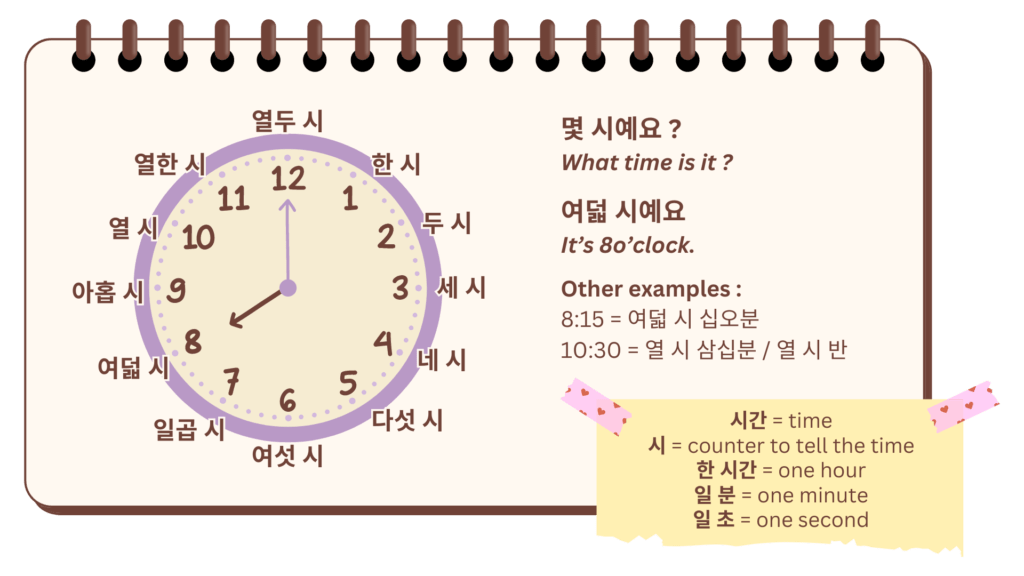
In Korean, telling time combines native Korean numbers for hours and Sino-Korean numbers for minutes.
You will need to know both systems to tell the time, or in many situations requiring numbers in Korean. But let’s focus on time today.
| Native Korean Numbers (for hours) | Sino-Korean Numbers (for minutes) |
| 1 : 하나 → 한 시 (1 o’clock) 2 : 둘 → 두 시 (2 o’clock) 3 : 셋 → 세 시 (3 o’clock) 4 : 넷 → 네 시 (4 o’clock) 5 : 다섯 → 다섯 시 (5 o’clock) | 1 : 일 → 일 분 (1 minute) 2 : 이 → 이 분 (2 minutes) 3 : 삼 → 삼 분 (3 minutes) 4 : 사 → 사 분 (4 minutes) 5 : 오 → 오 분 (5 minutes) |
Improving the Sentences
In this story, as it is a story for baby beginners, the sentences are not connected. In Korean, you can connect the sentences in many ways. Let’s see some of them through the story.
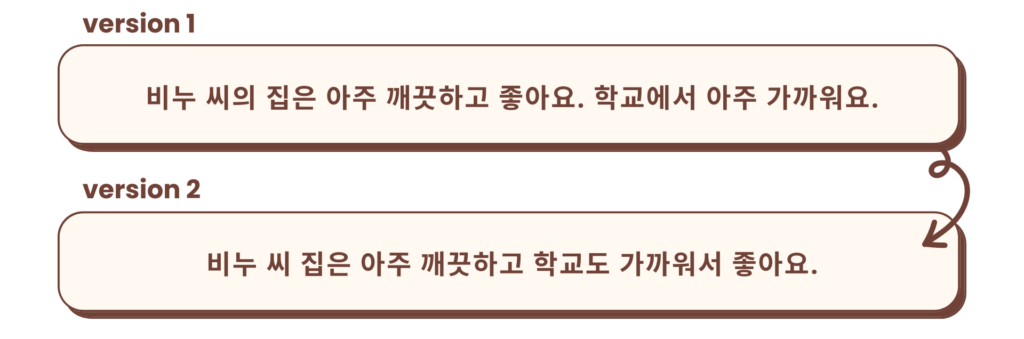
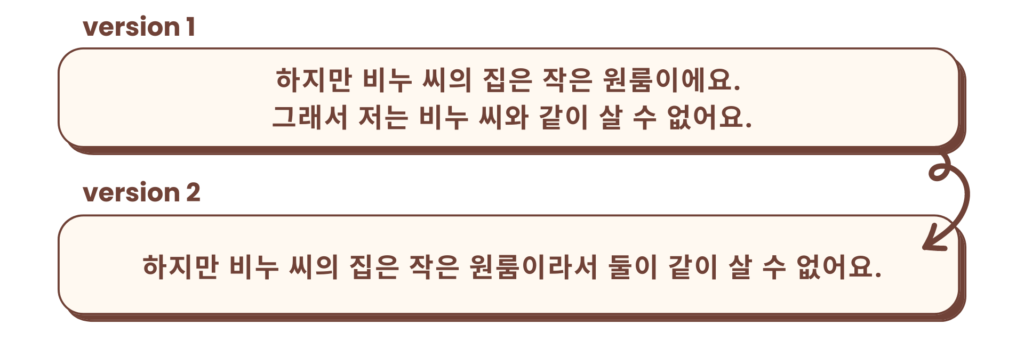
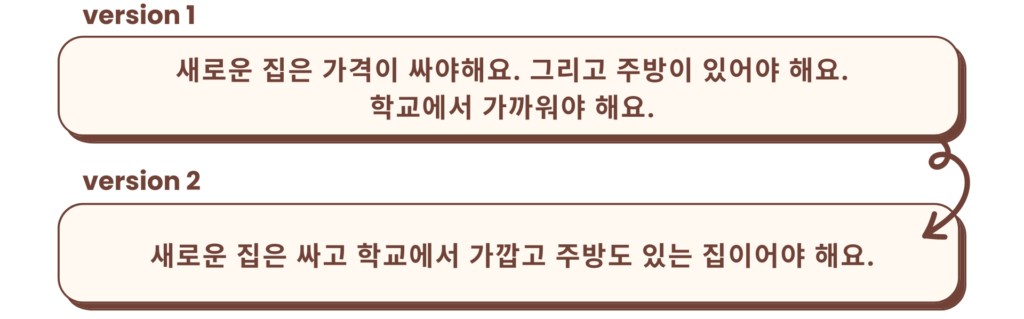

You can find more of these in the YouTube video related to this reading / listening practice. 🙂
Other Texts For Beginners
- Korean Reading for Beginners : Welcome to Korea!
- Korean Reading for Beginners : Swimming Pool
- Korean Reading for Beginners : Please help !
- Korean Short Story : 공부 ? Study ?
- Korean Short Story : Phone conversation
Study Method for Texts
If you’re not familiar with text study, here’s a method I would suggest you try.
Since we’ve recently started making YouTube videos for each reading practice we post, I would suggest you watch the video to study the text.
The video is divided as follows :
- Korean voice only, with pictures to help the understanding
- Korean subtitles + translation
- Additional notes
By following the video first, you’ll get a good grasp of the text. Then, you can come back here and study it from here.